A personal reflection on three issues that require “Upstream Thinking”
Homelessness, Health Care, and Poverty

I have been retired for over 10 years. I was an Executive Director for over half of my work life. I asked the question, “Do you want to treat the symptoms or do you want to treat the disease?” more than a few times over 20 plus years of leadership. Employees knew what this phrase meant. It wasn’t going to be a fix using procedures, resource, etc. we had. We were going to have to change or create. There was hard work ahead.
Through my Basic Income Guarantee (BIG) advocacy work I have had the pleasure of meeting and working with a few dedicated professionals who don’t talk like me or think like me. It is tremendously invigorating. They don’t talk about symptoms and diseases. They talk about “upstream thinking.” They have a great little cartoon to explain what they mean by this. Just a warning though, there are adults throwing children, that don’t seem to know how to swim, in a river! I hope you’ll take the 2 minutes needed to watch it.
Following are three personal reflections on, the new to me 😉, “upstream thinking”
1. Homelessness
This time last year I went to a few meetings about people without housing in our town. There were eight people in this situation in our town. Five were living in tents in a small public area near our library. The winter was coming and townspeople were concerned, including me. I could not just watch if Tom Joad and his family were going to spend the winter in a tent in my town. (If the name doesn’t mean anything to you, I’d highly recommend a read of The Grapes of Wrath.)
I listened to the stories of those in attendance: the calls to police, the fighting among the people living in the tents, the bureaucracy, the lack of resources, the employee with office hours who did not have anyone show up to ask for help, the willingness of towns people to help if they only knew what to do, the buck passing, the offers of help being rejected and accepted for various reasons.
I facetimed into a Town Council meeting that had homelessness on the agenda. During the meeting two employees from two different organizations gave short presentations on their respective organization’s efforts to help the people without housing in town. At the end of the presentations one of the town councilors asked the two people sitting beside each other giving the presentations what was the main reason for the people in our town not having housing. Without looking at each other, consulting notes, etc. they both answered simultaneously – mental illness.
My thinking changed from old, retired guy to Executive Director pretty quickly, i.e., let’s get people who are unhoused dignified living arrangement and get on with addressing the real problem(s). I think “upstream” they call that a “Housing First” solution?
2. Health Care
You can’t live in our province without knowing in the fiber of your being that we are in a health care crisis. For years the media, traditional and social, have been telling us this at every opportunity. Familiarity is truth.
I just spent a total of eight continuous days in two hospitals. Let me tell you my truth.
I was in three wards during my hospital stay. One of the wards I was in twice.
In the first ward my three ward mates were all older than me. I’m 66. One was acutely ill: one was chronically ill: one was either mentally ill or had Alzheimer’s disease (I never met or saw the ever present, Larry).
The second time I was in this ward, two of my ward mates were older than me, one was not. The one that was not was acutely ill. Of the two that were older than me one was chronically ill and the other was dying.
In the second ward I was in, all four of my ward mates were older than me. One was acutely ill. The other three had ailments that were being managed and they were waiting for somewhere else to go: one to die, the other two to be supported for the rest of what life they had left.
The third ward I was in was in the second hospital. Of my two ward mates, one was older than me and acutely ill, the other was younger than me and acutely ill.
Eleven ward mates, including me, of the total of 13 were over the age of 65: 85%.
In hindsight I was probably too sick to revert to Executive Director mode. I didn’t have to. One of my family members was way ahead of me. I’m paraphrasing here but what was said was something like - I thought we had a health care crisis? We have a seniors’ care crisis!
Don’t think you can deal with the health care crisis for now by throwing money at it and waiting for me and my peers to die off. There are approximately 250,000 people over 65 in our province now (22.5%-23.5% of the population) and in 15 years from now, according to our own government, there will be approximately 328,000 (29%-30% of the population).
We need some “upstream thinking” if we are going to prevent our acute care hospitals from becoming seniors’ care facilities.
3. Poverty
Since the summer I’ve posted a series of four articles on my list of reasons people have for supporting a BIG. Almost all of them fit into two categories: 1. prevent people from falling into poverty, or, 2. get people out of poverty. A few examples from my list:
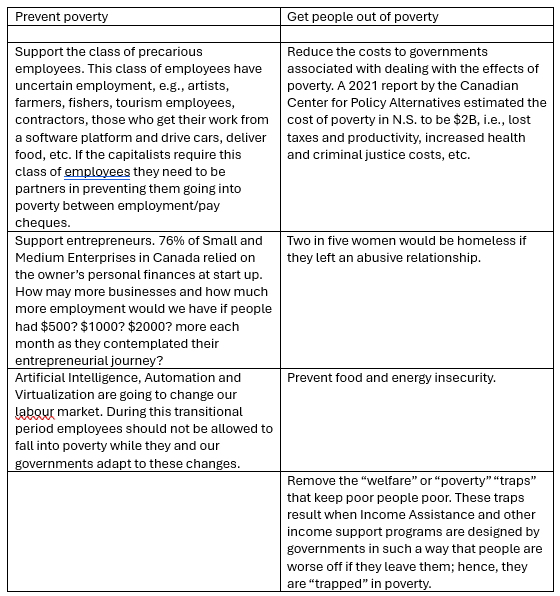
I have 35 reasons for a BIG on my list.
In Nova Scotia, Canada we are not willing to have children and Seniors live in poverty. The Canada Child Benefit reduced child poverty in Canada from over 16% prior to implementation to approximately 10% now. Old Age Security / Guaranteed Income Supplement reduced senior’s poverty from approximately 30% prior to full implementation to approximately 5% now. What do we have against 18 - 64-year-olds?
A Basic Income Guarantee is “upstream thinking”.
If I have used a stat., made a claim, etc. and you’d like to know where I got it from send me a note via email – jf4175535@gmail.com – and I’ll get the reference to you.